Funding sustainability tech: Why technical innovation is no longer enough
By Dr Chloe Sharp and Matt Langford
The default sustainability tech funding pattern usually starts with grants and maybe a bit of equity once the prototype is working. Revenue much later, if at all. The science is too early for VCs and the hardware too expensive for self-funding. So founders line up grant funding and treat them as the runway.
The commercial evidence needed for grants has grown
Letters of support (LoS) and letters of intent (LoI) are no longer optional on a grant application. Sales forecasts have to be defensible, not aspirational. Route-to-market sections have to show that someone with budget authority has agreed to engage. We see consistently strong applications failing because the commercial section reads like a wishlist or focuses too much on top-down, global market reports. Assessors at Innovate UK and equivalent bodies have visibly changed their view on commercial evidence in the last eighteen months. The grant is closer to an investment decision than a research one, and it expects evidence at that level. Similar to an investor.
For founders who treated grants as the early-stage funding because grants do not require commercial proof, can’t continue with this line of thinking any more. The grants do require commercial proof now. The same evidence an investor would expect to see in a seed round is increasingly what grant assessors expect in the commercialisation section of the form.
Revenue is closer than founders believe
The grant-first approach assumes there is no access to revenue. However, most sustainability tech founders are closer to revenue than they think, and crossing into the first commercial signal makes everything else, including grants, easier to fund.
A TRL 3 or 4 prototype that works in the lab can often generate revenue through human-led service delivery before the manufacturable, certified product is anywhere near ready. The lab-based analytical service that delivers the same report from samples a customer ships in to you can be sold next quarter. The carbon accounting tool that runs as a managed service before it runs as AI-enhanced software can be invoiced now. You are selling the outcome the long-term product is supposed to deliver, by whatever method delivers it now, rather than the product itself.
When you combine both the commercial evidence and early sales, you’re in a better position to be competing for grants. Sometime labels can hold you back. You may have not considered early revenue from what you have developed early on, because you have categorised yourself as pre-revenue.
The funding mix that works in 2026
The right funding portfolio for a sustainability tech venture in 2026 has three layers, running in parallel.
The commercial signal, even at small scale: A paid pilot, paid pre-orders on a waitlist, a refundable deposit, a service contract, a letter of intent tied to a procurement framework. Anything where someone with budget authority chose to spend it. This is the layer most founders skip and then try to compensate for at the grant or investor stage. It is also the cheapest layer to generate, because it does not require the finished product.
Grants, applied for with the commercial evidence: The same grant application reads completely differently when the commercialisation section is anchored to a paid pilot result or a procurement framework LOI rather than to a sentence beginning "we anticipate". Sharp Insights' grant success rate runs at 80% across our client base, and a meaningful share of the difference between that and the sector average comes from clients arriving at the grant application with commercial evidence already available to inform the write.
Investor relationship, started twelve months before the raise: The 2% conversion rate on cold outreach to investors you have never met is the wrong benchmark to plan against. The benchmark to plan against is the warm conversation with the investor early on, who watched you do what you said you would do over the previous four quarters. That investor watched the LOI come in, then the pilot result, then the grant award. By the time you ask for money, they already trust the team. Trust is the single biggest risk an investor prices into a seed-stage decision, and you can remove it before you ask for the cheque, but only if you started the relationship long enough ago. This is why second-time founders start with networking.
The cumulative effect is the venture that walks into a raise twelve months from now with paid pilots, two grants in flight, three investor relationships that have been live for a year, and a credible run-rate forecast based on signed commercial evidence. The terms that venture raises on are not comparable to the terms a same-stage venture raises on having relied on grants and a cold outreach round.
This is not an argument against being grant-first
Non-dilutive funding remains the right pathway for sustainability tech that has genuine deep technical work to do, and we have raised over £10 million in grant funding for clients to that end. It is an argument against grants as the only layer. Founders who treat grants as the funding strategy are increasingly applying for them with the wrong evidence base and watching them fail.
Nor can revenue replace grants in deep tech. Some of the work is genuinely capital-intensive and long-cycle, and grants exist precisely to fund that. The point is that the commercial layer should be running underneath the grant layer, generating the evidence the grant assessors now expect to see and the investors will price into the round.
Where to start
If you are at the grant-first stage and one of these layers is the one you are not running, that is the first place to look. The commercial signal layer is usually the cheapest to start and the most consequential for the layers above it. For hardware and hybrid ventures, where the route from prototype to paid pilot has its own constraints around certification, delivery mechanisms and pilot structure, the companion piece by Matt Langford at People Product Planet covers that ground from the product side.
Sharp Insights works with founders across all three layers: the commercial validation that generates the signal, the grant strategy and writing that builds on it, and the investor-readiness work that closes the gap between the build and the raise.
——————————————————————————————————————————————————
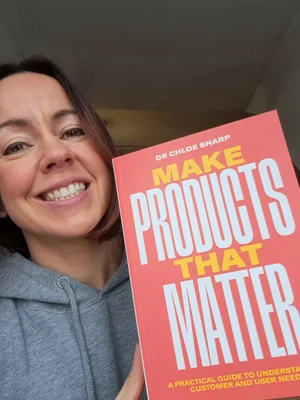
Dr Chloe Sharp is co-founder of Sharp Insights, a commercial growth partner for pre-Series A founders in deep tech, applied AI, health and climate tech. PhD in psychology, behavioural science and sociology, author of Make Products That Matter, ILM7 coach, angel investor, Innovate UK assessor. Start with a free 30-minute call by following the link on sharpinsights.co.uk/founders.
Matt Langford is a hardware tech product designer who works with MedTech, AgriTech and CleanTech ventures at People Product Planet on the journey from prototype to paid pilot. To find out more, and arrange an intro call here: https://peopleplanetproduct.co.uk/