Prototype-to-paid: from product development to commercialisation in sustainability tech
By Dr Chloe Sharp, Sharp Insights, with Matt Langford, People Planet Product
Product development for sustainability tech is harder than the standard SaaS playbooks acknowledge. Most product development thinking comes from software, where iteration is cheap and shipping-to-learn happens weekly. Sustainability tech often involves a blend of software and hardware, regulation, long payback periods and multi-stakeholder buying decisions, and each commercial assumption is months in the building before it can be tested.
Product development typically happens in isolation from the buyers whose decisions determine whether any of it ever ships, and there is no record of even one user paying for something that solves even one version of the problem. Investors price that gap, and grant bodies increasingly will not move without letters of intent attached to a credible route to market, and we’re seeing this across places such as the recent UKRI 2026-2031 strategy.
What works is product development that holds commercial signals as a forcing function from the first month. Not "we will commercialise once it works", but commercial signal feeding back into what gets built next, while the build is still happening. Every venture passes through the same five phases between idea and a commercially viable product. What follows is how they look from where we sit, working on the commercial side with founders across the spectrum, with particular attention to the software and data end. Matt Langford covers the same lifecycle from the hardware side on the People Planet Product blog [blog link to come].
The five phases from the commercial side
Discovery is demand validation, not engineering, and it does not need a working product. It has two questions, and conflating them is expensive. Does the problem exist, painfully and urgently enough that the person is already doing something imperfect to solve it? And does your proposed outcome, not your technology, actually solve it? Ask them together and a "no" tells you nothing, because you will not know whether the problem was too small or the solution missed the brief. For software and data ventures, twenty good interviews and a landing page will usually triangulate demand, which is precisely why skipping this phase is inexcusable at that end of the spectrum.
Definition fixes the outcome the product will deliver, in the buyer's terms, before the engineering team locks in a spec. "If I could save you 30% on your annual water bill at this upfront cost, would that work for you?" tests the proposition without revealing how, and a no on price or payback saves two years of build. The commercial detail that matters most here is the budget cycle. Software ROI usually lands inside the annual cycle the buyer is operating against: spend this in Q1, see this back by Q4. Lead with that. A common failure is leading with ESG claims to a buyer whose KPI is operational; reverse the order, and let the impact story carry the buyer through internal approvals rather than opening with it. The other failure is defining the product by its features rather than its outcomes. Features can only be tested by handing someone a prototype. Outcomes can be tested with a conversation and a credible commitment.
Prototype is the first technical build: the MVP, the wizard-of-Oz version, the rapid iteration cycle. The trap is building toward the long-term technical vision instead of the minimum that tests whether the outcome is real. Software can rebuild weekly, which makes the discipline easier to hold but also easier to abandon, because a team that can iterate fast will happily iterate on the wrong thing.
Pilot is the first paid signal, and it opens with an uncomfortable question: what is stopping you from packaging up an offer this month and putting it in front of a real buyer? Not the finished product, but the smallest version of the outcome someone with a budget would pay for. Software has had names for this for years: the concierge MVP, the manual back-end, the managed service that becomes a platform later. Whatever the engagement is called, structure commercial terms into it before it starts. Decide what success looks like and what success gets the venture next. If an incredible result still leaves you in the same conversation six months later, the engagement was an unpaid consultancy funded by your time and running costs. Even a free arrangement can carry commercial terms: when we hit this target, we move to a paid programme at this price, with a letter from the buyer agreeing to the conditional next step. That structure converts. Open-ended free arrangements do not.
Productisation is where the scalable product gets built and most of the capital is spent, and the discipline of the whole lifecycle is that it comes after Pilot, because Pilot tells you what the product actually needs to be. For software this is largely replacing the manual back-end with the platform and hardening the infrastructure. Years of build that end with a perfect product looking for a market is the failure mode this lifecycle exists to prevent, and the UK is particularly prone to it: US founders tend to ask how the venture makes money immediately, while their UK equivalents default to grants and equity for longer than the venture justifies.
That last point is where the lifecycle stops being a product methodology and becomes a funding strategy, because the way sustainability tech gets funded is changing in ways that make this discipline less optional than it used to be.
Grant applications need commercial evidence
Letters of support and letters of intent are no longer optional on a grant application. Sales forecasts have to be defensible rather than aspirational, and route-to-market sections have to show that someone with budget authority has agreed to engage. We see consistently strong applications failing because the commercial section reads like a wishlist. Assessors at Innovate UK and equivalent bodies have visibly hardened on this in the last eighteen months. The grant is closer to an investment decision than a research one, and it expects evidence at that level.
For founders who treated grants as the early-stage funding precisely because grants did not require commercial proof, this is a structural problem. The same evidence an investor would expect in a seed round is increasingly what grant assessors expect in the commercialisation section of the form. In lifecycle terms, the application now assumes you have done Discovery, Definition and at least the beginnings of Pilot.
Revenue is closer than founders believe
The second pressure on the grant-first pattern is the revenue you were assumed not to have access to. At the software and data end of the spectrum, the delivery mechanism can be a person long before it is a platform. The carbon accounting tool can run as a managed service, with an analyst producing the numbers behind the scenes, and be invoiced this quarter. The ESG reporting platform can be sold as a quarterly report compiled by hand while the automation is still being built. The climate data product can be delivered as a monthly briefing to three paying customers before a single dashboard exists. The buyer is paying for the outcome, and the outcome does not care how it was produced.
Yet climate software founders routinely categorise themselves as pre-revenue while sitting on a deliverable service. The result is a venture competing for grants under a higher evidence bar without the commercial evidence that would make it competitive, and using grant timelines to defer investor conversations that take twelve months of relationship building to convert.
The funding mix that works in 2026
The right funding portfolio has three layers, running in parallel.
The first layer is the commercial signal, even at small scale: a paid pilot, a service contract, a letter of intent tied to a procurement framework. Anything where someone with budget authority chose to spend. This is the layer most founders skip and then try to compensate for at the grant or investor stage, and for software ventures it is the cheapest to generate because it barely requires a product at all.
The second layer is grants, applied for with the commercial evidence in hand. The same application reads completely differently when the commercialisation section is anchored to a paid pilot result rather than to a sentence beginning "we anticipate". Sharp Insights' grant success rate runs at 80% across our client base, and a meaningful share of the difference between that and the sector average comes from clients arriving at the application with commercial evidence already in hand. The grant is not the start of the commercial conversation but the build-out of it.
The third layer is the investor relationship, started twelve months before the raise. The 2% conversion rate on cold outreach is the wrong benchmark to plan against. The right benchmark is the warm conversation with the investor who watched you do what you said you would do over the previous four quarters: who saw the LOI come in, the pilot result, the grant award. Trust is the single biggest risk an investor prices into a seed-stage decision, and you can remove it before you ask for the cheque, but only if you started the relationship long enough ago.
To be clear about what this is not: it is not an argument against grants. Non-dilutive funding remains the right floor for sustainability tech with genuine deep technical work to do, and we have raised over £10 million in grant funding across our client base to that end. It is an argument against grants as the only layer. Nor can revenue replace grants in deep tech, where some of the work is genuinely capital-intensive and long-cycle. The point is that the commercial layer should run underneath the grant layer, generating the evidence assessors now expect and investors will price into the round.
Where to start
If you are at the grant-first stage, the commercial signal layer is usually the cheapest to start and the most consequential for everything above it. For software and data ventures the question is simply which version of the outcome you could deliver manually this quarter, and to whom. For hardware and hybrid ventures, where each iteration costs months and regulation puts a floor under what can be shipped, Matt Langford's companion piece at People Planet Product takes the same lifecycle through the hardware lens, from mapping the buying committee to structuring pilots that convert.
Sharp Insights works with founders across all three layers: the commercial validation that generates the signal, the grant strategy and writing that builds on it, and the investor-readiness work that closes the gap between the build and the raise.
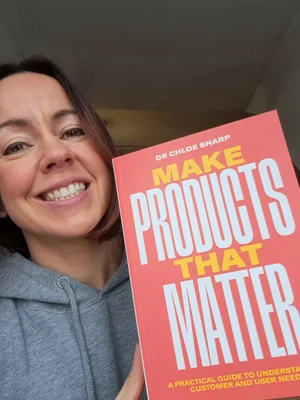
Dr Chloe Sharp is co-founder of Sharp Insights, a commercial growth partner for pre-Series A founders in deep tech, applied AI, health and climate tech. PhD in psychology, behavioural science and sociology, author of Make Products That Matter, ILM7 coach, angel investor and Innovate UK assessor. Start with a free 30-minute call at sharpinsights.co.uk/founders.
Matt Langford is a hardware product designer and commercialisation strategist at People Planet Product, working with spin-out and research-based hardware startups from lab bench to products in customers' hands. peopleplanetproduct.co.uk.