What evidence and when: Commercialising complex innovation across software, hardware and hybrid
By Dr Chloe Sharp, Sharp Insights
Part of a two-part series with Matt Langford, People Planet Product
The problem in sustainability tech is not a lack of ambition. It is the gulf between the prototype in the lab and the mission on the pitch deck, which sits across every important commercial question the founder has not yet answered. Who needs this? Who buys it? What outcome matters? What will they pay? Whether anyone will commit to the technology before the finished product exists.
The response many technical founders reach for is more development: another prototype cycle, better performance or just one more certification milestone. All of which is expensive, none of these addresses the commercial uncertainty at the heart of the venture.
The alternative is usually described as traction-first thinking. In its native SaaS form, talk to customers, ship the MVP, iterate on usage, it does not survive contact with complex innovation. A hardware venture cannot push a weekly release. A deep tech proposition cannot A/B test its way to a market. A regulated product cannot be handed to a customer before it is certified. Founders lose the plot in one of two directions from there. They either import the SaaS playbook unchanged and get stuck as it’s not easy to translate. You cannot ship-to-learn when each iteration is months and serious capital. Or they conclude that traction-first thinking does not apply to them, retreat to the lab, and get through the seed round on a product no one has committed to buy.
Traction-first thinking applies across the sustainability tech spectrum. The mistake is assuming that traction always means what it means for SaaS. Traction, properly understood, is the specific commercial evidence needed before the next important commitment. What counts as evidence changes by proposition, market and phase.
That is the frame Sharp Insights uses when working with founders across deep tech, applied AI, health, climate tech and hybrid innovation. Six stages with one question at each. The stages apply consistently across the spectrum. The evidence underneath them does not, and is adjusted depending on the technology and sector.
MAP: Decide what to learn next
Founders rarely arrive at commercialisation with a blank sheet. There is usually a prototype, a body of research, some IP, a grant, a list of possible applications, maybe a handful of customer conversations. The problem can be deciding what uncertainty matters most before committing to the next round of work.
MAP asks the question that should sit above every other stage. What decision are we trying to make and what must we know before we commit? It highlights what is already known and what is not. What technical and commercial maturity looks like today. Which applications the team is currently pursuing and which they have assumed away without evidence. What runway looks like. What the next significant commitment will actually cost.
This matters most for complex innovation because the obvious next technical milestone is not always the most important business milestone. A team may be about to sink £250,000 into improving prototype performance when the more urgent uncertainty is whether the application is right. Another might be applying for a grant to automate a workflow that customers would already pay to receive as a managed service. MAP catches those mismatches before the money is committed, and we can explore this together in a discovery workshop.
EXPLORE: Understand the system, not only the user
For software ventures, understanding demand is often about understanding the user. Interviews, observation, landing pages. The buying decision is usually held by someone close to the user, sometimes the user themselves.
For complex innovation, hardware, materials, regulated technology, infrastructure, the person using the product almost never controls the budget. A crop analysis device might be operated by a farmhand, specified by an agronomist, purchased by a farm manager, financed by a lender, and audited by an insurer or food producer. Each of those actors has a different definition of what makes the product valuable. The farmhand cares about speed. The agronomist cares about data quality. The insurer cares about the evidence trail. Miss any of them and the deal does not close.
EXPLORE maps that system. Who experiences the problem? Who uses the product? Who specifies? Who pays? Who approves? Who installs, maintains and supports? Who can prevent adoption? And beneath all of that: how is the problem being addressed today, why is the current approach inadequate, what does the strongest initial application look like.
A concrete example. A deep tech agritech founder we worked with was building a £10,000 device for taking crop samples. The technical execution was excellent. Discovery interviews confirmed that yes, crop sampling was annoying. The problem was that at the farmer level, it was a £20 problem, not a £10,000 one. The same activity was much more painful one layer up the supply chain, where the financial consequences of bad crop data were considerably larger. The venture pivoted up the chain rather than down the spec sheet, and the product was substantially repositioned. That pivot only gets recognised if EXPLORE looks wider than the user, and across the system.
VALIDATE: Look for commitment, not enthusiasm
Positive feedback is not traction. "That is really interesting" is not traction. Willingness to attend a follow-up meeting is not traction. The question that separates interest from validation is not what people say. It is what they will do.
Meaningful commitment looks different across the spectrum. For a software venture, it might be an early paid subscription or a design partnership. For hardware or deep tech, revenue is still the strongest signal but not the only one available. Access to a site. Staff time allocated. Procurement involved. Data shared. A co-development agreement. A senior sponsor named. Any of these represents an organisation taking on cost, risk or reputational exposure to help the proposition move forward. That is traction. Curiosity, however sincere, is not.
VALIDATE develops proposition-demand fit. The questions are: does this create an outcome that matters. Will stakeholders choose it over their current alternative. Who will commit money, time, data, facilities, expertise or reputation. Who pays, through which budget. What has to change internally for them to adopt it. Why would they act now rather than in twelve months.
This is where the "too early" verdict often comes from. When investors say a venture is too early, they usually mean this stage is not there yet. Not enough people have made concrete commitments. The fix is not more prototype development. It is the harder, less comfortable work of returning to the market and asking for the commitment.
PROVE: Show the solution works in context
A technical prototype demonstrates that something can work. Commercialisation requires evidence that it can create value in the environment where it will actually be used. Those are different tests, and confusing them is one of the most expensive errors in complex innovation.
The evidence PROVE requires differs sharply by proposition. Applied AI needs task success, data quality, security, integration, human oversight, repeated use. Deep tech needs reproducibility, real-world performance, manufacturing feasibility. Climate hardware needs field performance, installation requirements, reliability at scale, certification, production cost, customer payback. A hybrid product needs all of the above plus interoperability between the physical and digital components.
PROVE is also where pilot design matters most. A pilot that produces a good result but leaves the founder in the same commercial conversation six months later has not produced traction, it has produced expensive theatre. Before a pilot starts, both parties should know what is being proved, how it will be measured, who will judge success, what happens if the threshold is met, and which commercial or procurement decision follows if it is. Without that structure, a pilot is unpaid consultancy the founder is funding for the customer.
ENTER: Find a route to market that works
Customer acquisition is a familiar concept in SaaS. For complex innovation, the route to market is often more varied and more decisive than the product itself. A company might sell direct, license the IP, enter a procurement framework, work through an engineering partner, integrate into another company's product, use a distributor, or run a project-based model. Which route is right depends on who has access to the customer, who can install and support the product, who carries the regulatory risk, and who has the commercial credibility to make adoption possible.
Software assumptions can mislead badly here. A founder does not necessarily need thousands of users or a scalable digital acquisition channel. A venture selling a high-value system to ten infrastructure operators can demonstrate strong traction through a small number of deep relationships. The evidence must match the market.
ENTER develops route-to-market fit. Can the company repeatedly reach the right opportunities? Can it navigate evaluation, approval and procurement. Should it sell direct, license, partner, distribute or integrate. Can it acquire and serve customers at an acceptable cost. Which partnerships are structurally necessary. Whether the route itself can become a source of strategic advantage.
GROW: build a venture, not a succession of projects
Traction does not end when the first customer signs. A venture needs to show it can deliver consistently, sustain its economics, fund the journey and build an organisation that is not propped up by founder heroics. It also needs to decide, honestly, what kind of business it is actually becoming.
This matters most for founders commercialising platform technologies. The same underlying technology might support several business models: manufacturing, licensing, project delivery, enterprise software, consulting, or some combination. The most technically ambitious model is not automatically the right one. It is not automatically the one the founder wants, or is best placed, to build. Commercialisation ultimately involves founder-business fit as well as product-market fit, and that is a conversation worth having earlier rather than later.
On the funding piece
For complex innovation, revenue, grants and investment should not be treated as sequential phases. They run in parallel, each supporting a different part of the journey.
Commercial activity generates evidence that the market matters. Paid feasibility work. An early service contract. A customer contribution. A structured pilot. Grant funding supports genuine technical uncertainty, field testing, certification, scale-up. In our experience, the strongest grant applications are the ones grounded in existing customer evidence rather than forecasts. Sharp Insights runs at an 80% grant success rate across our client base, and a meaningful part of the difference between that and the sector average comes from clients arriving at the application with commercial evidence already in hand.
Investor relationships should start well before the raise. Founders can use progress through the framework itself to show they understand their assumptions, make evidence-led decisions and deliver against agreed milestones. Cold outreach converts at around 2%. Warm outreach to an investor who has watched you do what you said you would over four quarters converts at a multiple of that. A useful sanity check on any funding ask: what would stop you from taking out a £200,000 loan tomorrow against the venture as it stands? Whatever the answer is, that is the risk an investor will price too. Reduce the risk and the terms improve.
Traction-first, applied to different technologies
Traction-first commercialisation works across software, hardware, deep tech and hybrid. What does not work is assuming that traction always looks like SaaS metrics. For software it might appear as activation, retention, expansion. For hardware, paid feasibility, site access, technical thresholds, structured pilots, progression toward procurement. For deep tech, reproducibility plus IP plus partner commitment. For hybrid, system-level evidence that the whole works, not just the parts.
The framework stays consistent because the underlying evidence cycle stays consistent. Decision, hypothesis, evidence, interpretation, commitment, learning. That is the essence of it. Not forcing every founder to behave like a SaaS company. Not delaying commercial work until the technology is ready. Just knowing what you need to learn before you commit more development, funding or commercial effort, and generating evidence credible enough to make the next decision honestly.
Once the next commercial uncertainty has been identified, the question becomes how to translate it into the right technical requirement, prototype or field test. Matt Langford's companion piece for People Planet Product looks at what traction-first thinking changes for physical product development specifically, from prototype design through to the transition into manufacturable form, which you can find here.
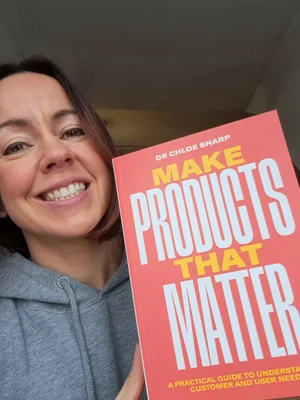
Dr Chloe Sharp is co-founder of Sharp Insights, an evidence-led commercialisation partner supporting founders across deep tech, climate tech, applied AI, health and hybrid innovation. Sharp Insights acts as an in-house commercial team, working through the MAP-EXPLORE-VALIDATE-PROVE-ENTER-GROW framework with founders to identify what needs to be known before committing further development, funding or commercial effort. The team has supported over 150 founders and secured more than £10 million in non-dilutive funding for clients, with an 80% grant success rate. Sharp Insights also runs Juno and Theia, AI assistants for customer discovery and demand validation. Chloe holds a PhD in psychology, behavioural science and sociology, is the author of Make Products That Matter, an ILM7 coach, angel investor and Innovate UK assessor. Start with a free 30-minute call at sharpinsights.co.uk/founders.
Matt Langford is a hardware product designer and product-development adviser with experience across MedTech, AgriTech and CleanTech. Through People Planet Product, he helps spin-outs and research-led ventures translate customer and market evidence into product requirements, prototypes and development plans, supporting the transition from lab-based technology to physical products that can be tested, manufactured and deployed. Need to translate customer evidence into the right next hardware build? peopleplanetproduct.co.uk